The Hidden Army of Time Travellers
When visitors marvel at the authenticity of Ludlow's Medieval Christmas, they witness the culmination of an extraordinary volunteer effort that begins months before the first torch is lit. These remarkable individuals represent perhaps Britain's most dedicated volunteer community, driven by a passion for historical accuracy that borders on the obsessive—and thank goodness for that obsession.
The depth of commitment required to transform ordinary people into convincing medieval characters defies modern expectations of casual volunteering. These aren't weekend hobbyists donning fancy dress costumes. They are serious historical interpreters who invest hundreds of hours researching, crafting, and perfecting every detail of their medieval personas.
The Research Revolution
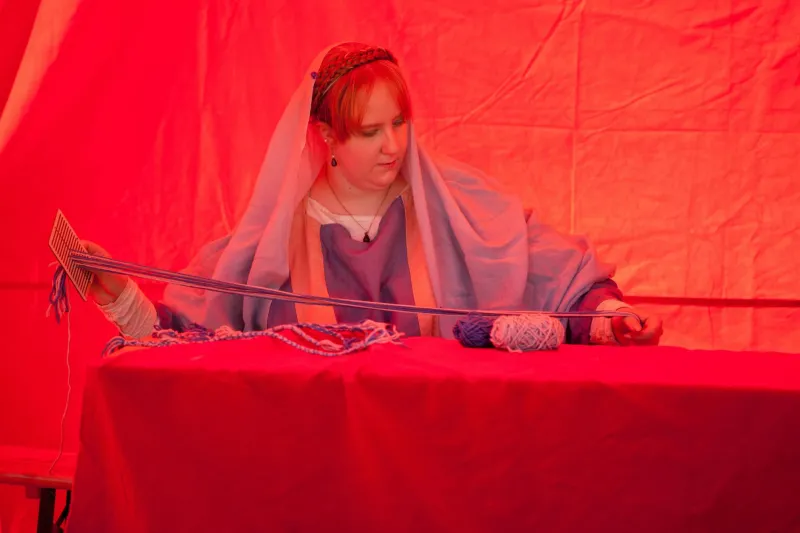
Sarah Matthews, a secondary school teacher from Birmingham, embodies this dedication perfectly. Her portrayal of a 13th-century wool merchant's wife at Ludlow requires her to master not just period-accurate clothing construction, but the intricate details of medieval commerce, social hierarchies, and daily routines that most university medieval studies courses barely touch upon.
 Photo: Sarah Matthews, via www.rawstory.com
"I spend my summer holidays in archives," Sarah explains matter-of-factly. "Last year, I travelled to Worcester Cathedral's manuscript collection to understand how wool merchants' wives actually dressed their hair. The festival visitors deserve authenticity, not Hollywood interpretations."
This research intensity extends across the entire volunteer community. Medieval reenactors routinely consult academic papers, archaeological reports, and museum collections to ensure their interpretations reflect genuine historical understanding rather than popular misconceptions.
The Craft of Authenticity
The financial investment alone demonstrates remarkable commitment. Quality medieval reproduction clothing costs hundreds of pounds per outfit, with many volunteers maintaining multiple period-appropriate ensembles for different social ranks and seasonal variations. Hand-sewn tunics, accurately woven fabrics, and properly constructed medieval footwear represent significant personal expenditure for purely voluntary activities.
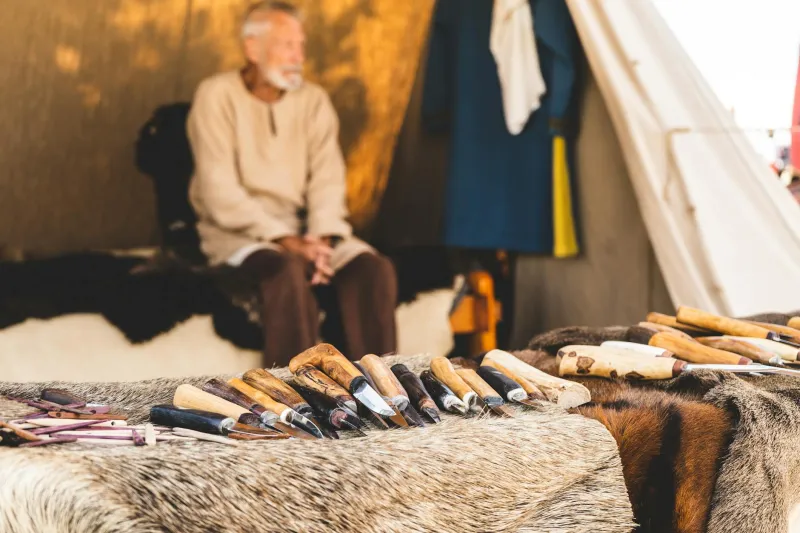
James Whitmore, a retired engineer from Telford, has spent three years learning traditional blacksmithing techniques to portray a medieval metalworker convincingly. His home workshop contains period-accurate tools and a coal forge, investments totalling several thousand pounds for skills he demonstrates freely during the festival.
 Photo: James Whitmore, via media.baselineresearch.com
"Modern people don't understand how sophisticated medieval craftsmanship actually was," James reflects whilst shaping iron using techniques unchanged since the 14th century. "Every hammer blow, every heating temperature, every cooling method affects the final product. Medieval smiths were genuine artists, and visitors deserve to see their skills properly represented."
The Language of the Past
Perhaps most impressively, many volunteers study Middle English and period-appropriate speech patterns to enhance their historical interpretations. Local amateur dramatic societies have formed medieval language study groups, meeting monthly throughout the year to practice archaic pronunciations and vocabulary.
Margaret Thompson, a librarian from Ludlow itself, coordinates these linguistic efforts with scholarly precision. "We're not attempting perfect historical reproduction—that would be incomprehensible to modern visitors. But incorporating authentic medieval phrases and speech rhythms creates atmospheric authenticity that enhances everyone's experience."
The group maintains extensive glossaries of medieval terminology, pronunciation guides, and social interaction protocols appropriate to different historical periods represented during the festival. New volunteers receive comprehensive training materials that would impress university medieval studies departments.
The Psychology of Transformation
What drives ordinary people to such extraordinary lengths for unpaid public entertainment? The volunteers themselves offer fascinating insights into this peculiar passion.
"There's something magical about stepping completely outside modern life," explains David Richardson, an accountant who portrays a medieval monk during the festival. "For those few days, I experience genuine connection to historical continuity. The same buildings, the same seasonal rhythms, the same human experiences that connected our ancestors to their community."
This psychological transformation extends beyond individual satisfaction. Many volunteers describe profound educational missions, believing historical reenactment provides more effective learning experiences than traditional classroom instruction.
The Community of Practice
The British medieval reenactment community extends far beyond Ludlow, encompassing hundreds of dedicated volunteers across the country who share resources, expertise, and mutual support. Online forums buzz with discussions about archaeological discoveries, historical interpretations, and practical crafting techniques.
This community maintains remarkably high standards through peer review and constructive criticism. Experienced reenactors mentor newcomers, ensuring quality improvements across the entire movement. The social bonds formed through shared historical passion create lasting friendships that extend well beyond festival weekends.
The Educational Impact
Professional historians increasingly recognise the educational value that dedicated reenactors provide. Their commitment to accuracy often exceeds that found in commercial historical attractions, whilst their enthusiasm for public engagement creates memorable learning experiences for visitors of all ages.
"These volunteers bridge the gap between academic historical knowledge and public understanding," notes Dr. Rebecca Harrison, a medieval historian at Birmingham University who regularly consults with Ludlow's reenactment community. "Their dedication to authenticity elevates historical education beyond entertainment into genuine cultural preservation."
The Unsung Recognition
Perhaps most remarkably, these extraordinary volunteers seek no recognition beyond the satisfaction of sharing historical passion with appreciative audiences. They arrive early, work tirelessly throughout the festival, and depart quietly, leaving behind memories that last lifetimes for thousands of visitors.
Their dedication transforms Ludlow's Medieval Christmas from simple entertainment into genuine cultural experience, connecting modern families to historical continuity through personal passion and meticulous preparation. They deserve recognition as Britain's most dedicated volunteers, preserving and sharing our medieval heritage with extraordinary generosity and skill.
Without their obsessive commitment to historical authenticity, Ludlow's Christmas celebration would lose the magical quality that distinguishes it from ordinary seasonal events. They are living history's unsung heroes, and we are all richer for their remarkable dedication.